

“An ounce of prevention is worth a pound of cure” as the saying goes. When it comes to residential fires, this adage is particularly apt.
The purpose of this blog is to increase your awareness of potential fire ignition sources in residential settings and by being aware of how typical fires start, will help you begin to take an active role in preventing these fires from occurring. We will also discuss commonly available products that can improve your chances of successfully dealing with a fire situation. Lastly, some basic elements of a fire safety plan will be shared.

Let’s begin by listing common sources of fire ignition in typical homes.
– Smoking
– Candles
– Oil or gas-soaked rags piled in a corner
– Frayed electrical cords
– Overloaded outlets
– Extension cords used as permanent wiring
– Dryer lint traps
– Stovetop cooking
– Amateur wiring installations
In recent years, rechargeable Lithium-Ion batteries used in so many household items have become an increasingly common source of residential fires

Being aware of ignition sources is only the first step in fire prevention. Many sources, but not all, are benign on their own and need to be close to flammable materials to present a danger. Thus, prevention also requires that flammable materials such as clothing, paper, and synthetic materials are kept away from intense sources of heat such as a stove element or flame. Virtually every synthetic fibre as well as plastics, are made from petrochemicals, and petrochemicals burn quite well. Fires triggered by an open flame or intense heat source such as a lit cigarette or heating element are relatively instantaneous in that a flammable item that is close to one of these sources usually hits its ignition point quickly and bursts into a visible fire. Other fire sources require the right conditions and time to become an ignition source. Oil or solvent soaked rags take time to generate enough heat to ignite the material. Likewise for frayed electrical cords, extension cords used to power appliances and over-loaded outlets. Excessive dryer lint can cause a heat build up inside a dryer or for gas-powered dryers, provide the flammable material that can ignite. Preventing fires requires an awareness of your surroundings. Use your senses; smell, sight, hearing and touch, to identify a situation that isn’t normal such as scorch marks, a burning smell, scraping in appliances with rotating fan blades, and vacuum cleaner, power tool or extension cords that have gouges or cuts in the protective coating.
So, step one in fire safety is…prevention!

Our next area of discussion deals with commonly available products that can improve your chances of successfully dealing with a fire situation by making you aware of a potential fire, by helping to properly suppress it or by simply aiding in your escape.
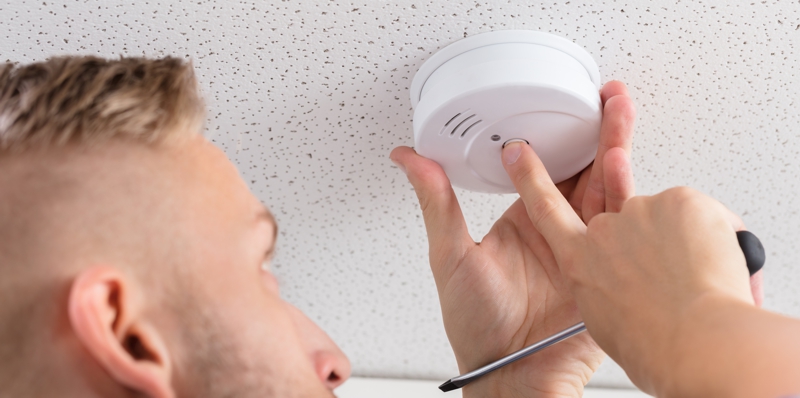
Properly sited and maintained smoke detectors are proven to save lives. Ideally, there should be smoke alarms outside of every room where occupants sleep. They should be on every level of a dwelling and in newer homes, are wired so that if one trips, all alarms on the circuit will activate. If there are hearing impaired residents in the dwelling, choose smoke alarms that have a visual signal such as a flashing light. Maintenance requires the changing of the battery backup periodically, testing it regularly and knowing that smoke detectors (and CO detectors) have useful lifespans after which they should be replaced. Check with your local fire department and the manufacturer of your alarms for guidance.
An investment in fire extinguishers is prudent. Not all fire extinguishers are created equal. There is a classification system to indicate what types of fire that each extinguisher is rated for. Here is a summary of the classifications:
Type A – This is for ordinary combustibles such as wood, paper and cloth
Type B – This is for flammable liquids such as gasoline, solvents, paints, oil & grease
Type C – This type is for fires involving ‘live’ electrical equipment including electrical wiring or a fuse box
Type D – This is for combustible metals and is not a common rating for portable residential extinguishers. In an emergency, for this type of fire, if it is small, sand can be used.
Type K – This rating is for commercial cooking equipment and is used for commercial cooking oil appliances. Once again, in residential applications for using cooking oil such as in deep fryers, a Type B rated extinguisher should suffice.
In addition to having an extinguisher that is properly rated for the common types of fire in residential settings, it is equally important to have the extinguisher sited where it can be easily and quickly accessed in the event of a fire.

Knowing how to operate the extinguisher is essential. A good resource can be found at the following Government of Canada site:
https://www.ccohs.ca/oshanswers/safety_haz/fire_extinguishers.html
So far, we’ve discussed potential ignition (fire) sources, steps to prevent fires from happening, and readily available products that can assist you in a fire situation. Imagine that you’ve done your best to prevent an unintended fire ignition, you are prepared in case there is an unintended ignition by have working smoke alarms and you have invested time and money in having portable fire suppression tools and training on those tools. The final section of this article deals with the emergency exit plan.
Every resident of the building should be knowledgeable about what to do and where to go in the event of a fire emergency.
Based on the potential areas in the residence where a fire could breakout, a plan needs to be in place for where to exit if the fire can not be safely contained and suppressed. If in a basement, there needs to be an easily accessible point of egress such as a sliding door or window large enough for an adult. On the main floor, where there are likely multiple points of egress, which door or window to choose will depend on the fires’ location. In a multi-story building, the exit plan needs to take into account the height from the ground for points of exit. If there is an exterior balcony or roof that can provide temporary safety, this needs to be accessible in an emergency. If there is nothing available, an escape ladder can be a life-saver. Not only do exits need to be accessible, but it is imperative that they can be quickly opened in the event of a fire situation. For example, doors that have a keyed or combination lock can effectively rule out that exit as usable in an emergency. A rally location should be specified so that residents can quickly be identified and accounted for. Reviewing the exit plan with each resident will increase the speed and effectiveness with which people can escape a fire.
In summary, residential fire safety is comprised of:
– being aware of potential sources,
– active prevention in terms of eliminating those sources as best possible,
– installing and regularly testing smoke alarms,
– installing and being trained on portable fire prevention tools such as fire extinguishers and
– having an emergency exit/escape plan in place and understood by all residents.

Disclaimer
Although every effort is made to ensure the accuracy, currency and completeness of the information, Arcon Engineering Consultants Ltd (AECL) and the author of this article do not guarantee, warrant, represent or undertake that the information provided is correct, accurate or current. AECL and its employees are not liable for any loss, claim, or demand arising directly or indirectly from any use or reliance upon the information.